

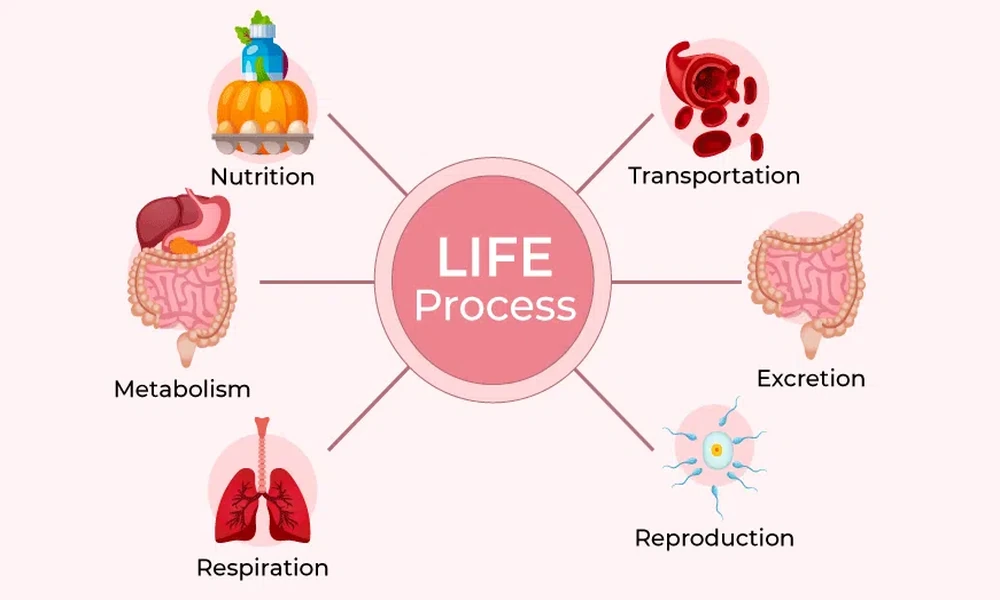
Have you ever wondered how your body continues to work even when you are sitting quietly or sleeping? Walking, running and playing obviously require energy, but the body also needs energy for breathing, digestion, growth, repair and other essential functions. Food supplies the nutrients that help living organisms obtain this energy and carry out their daily activities. For students revising the topic, class 10 life process notes can be useful for bringing these connected processes together in one place.
Life does not depend on a single function. Different processes work continuously inside an organism to keep it alive. Nutrition provides the materials needed by the body, respiration helps release energy from food, transportation carries useful substances to different parts, and excretion removes waste. These concepts are also an important part of class 10 science notes, especially while preparing the biology portion of the Class 10 Science syllabus. The explanations here follow the concepts presented in the NCERT Class 10 Science textbook.
What Are Life Processes?
Living organisms perform several basic functions that are necessary for their survival. These functions are called life processes. Even when an organism appears inactive, many processes continue inside its body. Class 10 Science Notes on Life Processes help students understand these essential activities in a clear and structured manner.
Nutrition, respiration, transportation and excretion are the major life processes studied at this level. They are closely related to one another. For example, an organism first needs food through nutrition. The food can then be used to release energy through respiration. Transportation helps move oxygen, nutrients and other substances to the required parts of the body, while excretion gets rid of metabolic wastes.
Nutrition in Living Organisms
Nutrition is the process by which organisms obtain food and use it for energy, growth, repair and maintenance. The way an organism obtains nutrition depends on its structure and mode of living.
There are two broad modes of nutrition: autotrophic nutrition and heterotrophic nutrition.
Autotrophic Nutrition
Green plants are generally autotrophic because they can prepare their own food. They use carbon dioxide from the air and water obtained from the surroundings to make food in the presence of sunlight and chlorophyll. This process is known as photosynthesis.
During photosynthesis, light energy is converted into chemical energy and stored in the food produced by the plant. The food formed can be used for obtaining energy and for other activities such as growth and repair.
Carbon dioxide enters the leaves through tiny openings called stomata. Water and minerals are absorbed from the soil and transported to different parts of the plant. Chlorophyll present in green parts of the plant helps capture light energy.
A simple representation of photosynthesis is:
Carbon dioxide + Water → Glucose + Oxygen
The process requires sunlight and chlorophyll.
Photosynthesis is particularly important because it provides food for plants and forms the base of food chains. Animals and many other organisms ultimately depend on plants for food, either directly or indirectly.
Heterotrophic Nutrition
Heterotrophic organisms cannot prepare their own food in the way green plants do. They obtain food from other organisms or from organic matter present in their surroundings.
Animals are familiar examples. A deer feeds on plants, while a lion obtains food by feeding on other animals. Their food sources and feeding habits are different, but both depend on other organisms for nutrition.
Fungi also show heterotrophic nutrition. They commonly obtain nutrients from organic matter in their surroundings. Depending on the organism, food may be taken in and then digested, or nutrients may be absorbed after digestion outside the body.
The method of obtaining food can therefore vary widely among organisms. What remains common is their dependence on an external source of organic food.
Respiration
Getting food is only one part of the process. Cells need energy to perform their functions, and respiration helps release energy from food.
In respiration, food such as glucose is broken down to release energy. This energy can then be used by cells for different activities. Respiration takes place in living cells and is therefore essential for survival.
There are two main types of respiration discussed at the Class 10 level.
Aerobic Respiration
Aerobic respiration takes place in the presence of oxygen. Glucose is broken down to produce carbon dioxide, water and energy.
Glucose + Oxygen → Carbon dioxide + Water + Energy
Aerobic respiration generally releases more energy because the breakdown of glucose is more complete.
Anaerobic Respiration
Anaerobic respiration occurs when oxygen is not available. In yeast, for example, glucose is converted into alcohol and carbon dioxide, releasing some energy.
Muscle cells can also temporarily carry out anaerobic respiration when there is insufficient oxygen during vigorous physical activity. In this case, lactic acid is formed.
The difference between aerobic and anaerobic respiration is mainly related to the availability of oxygen and the products formed during the process.
Transportation in Living Organisms
Once food and oxygen are available, they must reach the cells that need them. Waste materials produced during different cellular activities also need to be moved to places from where they can be removed.
This is why transportation is another essential life process.
Transportation in Humans
In humans, the circulatory system carries substances throughout the body. Blood is an important transport medium. It carries oxygen from the lungs to body tissues and transports carbon dioxide back towards the lungs.
Blood also carries digested nutrients, hormones and other substances to different parts of the body.
The heart acts as a muscular pump that keeps blood moving through blood vessels. Arteries generally carry blood away from the heart, while veins bring blood towards the heart. Capillaries are very small blood vessels where exchange of materials between blood and tissues takes place.
The human circulatory system therefore helps connect different organs and tissues, ensuring that cells receive the substances they require.
Transportation in Plants
Plants also need an internal transport system. Water and minerals absorbed by the roots must reach the stem, leaves and other parts of the plant. Food prepared in the leaves also needs to be transported to areas where it is required or stored.
Plants use specialised tissues called xylem and phloem for this purpose.
Xylem transports water and minerals from the roots towards the other parts of the plant. The movement of water is helped by processes such as transpiration.
Phloem transports food, mainly products of photosynthesis, from the leaves to other parts of the plant. This movement of food is known as translocation.
Excretion
Living cells produce waste materials as they carry out various chemical reactions. These wastes cannot simply remain in the body in large amounts. They need to be removed or managed properly.
The removal of metabolic waste from the body is called excretion.
Excretion in Humans
The human excretory system includes the kidneys, ureters, urinary bladder and urethra. The kidneys play a major role in removing nitrogenous wastes from the blood and forming urine.
Each kidney contains a large number of tiny filtering units called nephrons. A nephron filters the blood and helps separate useful substances from wastes. Some useful materials and water are reabsorbed according to the body’s requirements.
The urine formed in the kidneys passes through the ureters and is stored temporarily in the urinary bladder. It is eventually removed from the body through the urethra.
Excretion is therefore not simply the removal of urine. It is an important process that helps maintain the body’s internal balance by removing unwanted substances.
Excretion in Plants
Plants do not have specialised excretory organs like animals. They manage waste materials in several ways.
Some waste substances may be stored in parts of the plant such as leaves, bark or old tissues. Plants can also release certain substances through diffusion. Gases produced during different processes may leave through stomata or other openings.
Some waste products may also be stored in the form of substances such as resins and gums. When leaves or other plant parts fall off, the stored wastes can be removed from the actively growing parts of the plant.
How Are These Life Processes Connected?
Nutrition, respiration, transportation and excretion are not four completely separate activities. They depend on one another.
Nutrition supplies food and nutrients. Respiration breaks down food to release energy that cells can use. Transportation carries food, oxygen, water and other useful substances to different parts of the organism. At the same time, it helps carry waste materials towards organs or structures involved in their removal.
Excretion then removes metabolic wastes from the body.
This connection becomes easier to understand if you think about what happens after eating a meal. Food is digested and nutrients are absorbed. These nutrients reach cells through the transport system. Cells use them in respiration to obtain energy. The activities of cells produce waste materials, which are eventually transported and removed.
Quick Revision Points
- Life processes are essential functions needed to maintain life.
- Nutrition provides organisms with food and nutrients.
- Green plants show autotrophic nutrition and prepare food through photosynthesis.
- Animals and fungi are examples of organisms showing heterotrophic nutrition.
- Respiration releases energy from food.
- Aerobic respiration takes place in the presence of oxygen.
- Anaerobic respiration occurs without oxygen and produces different end products.
- Blood transports oxygen, nutrients and other substances in humans.
- Xylem carries water and minerals in plants.
- Phloem transports food from one part of a plant to another.
- Kidneys and nephrons play a major role in human excretion.
- Plants manage wastes through processes such as storage, diffusion and shedding of old parts.
Conclusion
Life processes keep an organism functioning from moment to moment. Food provides the materials needed for nutrition, respiration makes energy available to cells, transportation moves substances where they are needed, and excretion removes wastes. Understanding how these processes work together makes the topic much easier to remember and helps students see that the different systems of a living organism are closely connected.
